
Building community confidence starts before construction
Air quality is a top concern of communities located near new data center developments. Even where a project can meet its technical and regulatory requirements, we’re seeing local opposition challenge projects, delay approvals, reshape development plans and even shut down projects completely.
Residents want to understand what construction and long-term operations of a data center means for the environment and their health. Regarding air quality, questions often center around emissions from diesel generators, which have traditionally provided backup power but are increasingly serving as a temporary primary power source while facilities await grid connection. Construction-related impacts, including dust and emissions from vehicles and equipment, can raise additional air quality questions.
But those conversations cannot happen effectively after concerns arise.
Developers need to establish an objective record well before construction begins to create a common point of reference for understanding how conditions change over time.
Rather than capturing singular snapshots of conditions, data centers can use ambient air monitoring to create an ongoing environmental record. When that record shows a clear pre-construction baseline and how air quality changes throughout the project lifecycle, those critical community conversations can happen more proactively and be rooted in data.
Ambient air monitoring provides the context behind air quality
Ambient air quality is variable. Weather, traffic, seasonal conditions, wildfire smoke and nearby industrial sources can all influence what is measured around a site.
That makes context essential.
One higher reading on a particular afternoon can attract attention, but that reading alone does not explain what caused it or whether it represents a meaningful change. Continuous monitoring makes it possible to look beyond individual data points and examine patterns, trends and surrounding conditions.
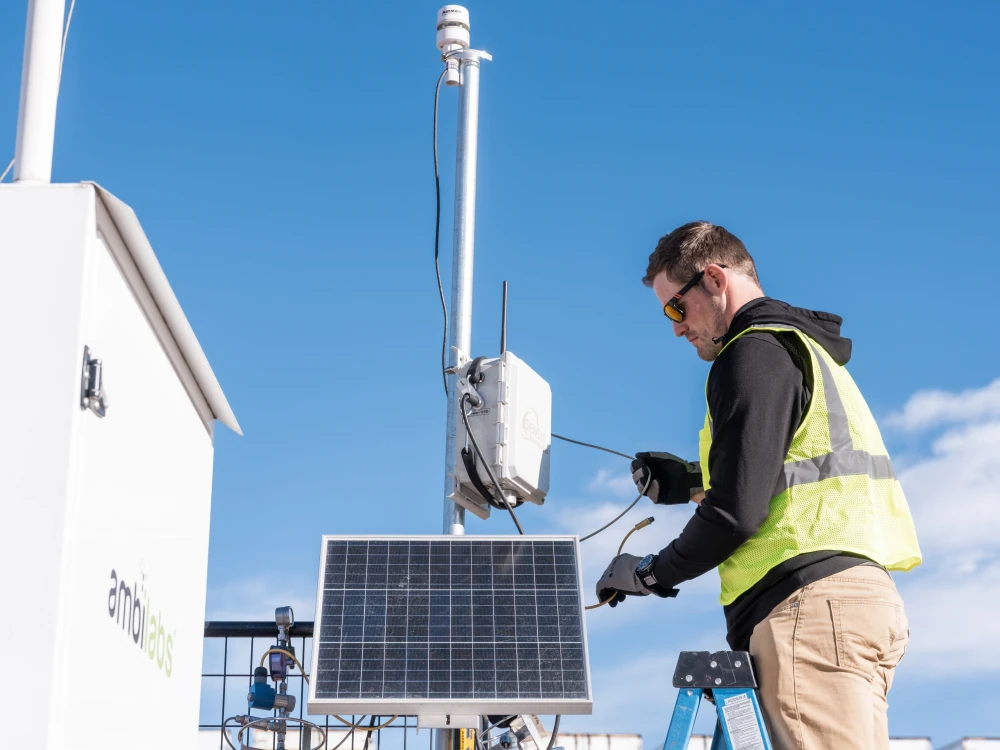
Establishing baseline air quality conditions before construction strengthens that context further. Timing matters: once construction begins, the opportunity to document true preconstruction conditions has passed. Monitoring around a site perimeter throughout the development of a data center can extend that record, creating a clearer picture of conditions at the property boundary and how they change over time. Starting before construction provides an objective point of reference that helps everyone understand what changes, if any, occur over time.
During construction, continuous monitoring can provide context around changing site conditions, including dust, vehicle traffic and equipment use.
During commissioning, monitoring can provide visibility into changing levels of pollutants at the fenceline related to onsite power generation and other activities, including volatile organic compounds (VOCs), nitrogen oxides (NOx), carbon monoxide and other compounds relevant to data center startup.
And once the facility is operational, continuous monitoring creates a longer-term record of conditions at the property boundary. Trends established over time can provide context when an abnormal reading or community concern arises and help operational teams, regulators and surrounding communities understand whether and how conditions have changed.
Transparency means sharing information before questions arise
Proactive transparency starts with understanding the questions a community has about a project. When those questions involve air quality, ambient air monitoring can provide measured data that helps put concerns into context rather than relying on assumptions about what is happening around the site.
Ambient air monitoring also changes how environmental information can be communicated. In addition to capturing the air quality data at the fenceline, developers can feed the collected data directly into an accessible online platform. Public-facing dashboards can present current conditions alongside historical trends, giving communities access to the same environmental record that project teams are using.
Public air monitoring programs used by other industries already demonstrate what this can look like in practice. The Commerce City-North Denver Air Monitoring program, for example, makes environmental data publicly available, providing a model for how measured conditions can be shared directly with surrounding communities and how complex environmental information can become more accessible.
The Commerce City-North Denver (CCND) Air Monitoring program demonstrates how industry is publicly sharing environmental data and the local air quality impact.
This level of transparency helps to earn the trust of the community before a complaint ever arises. Proactively sharing measured conditions and historical trends makes environmental performance visible rather than something communities are simply asked to assume.
That does not mean every data point tells a simple story. Environmental data still requires interpretation, particularly when conditions are influenced by multiple sources. But ambient air monitoring provides a factual, unbiased starting point for those conversations rather than leaving people to draw conclusions from isolated events or incomplete information.
Please note the above video is a purely conceptual mockup of what an ambient air monitoring dashboard could look like for a data center campus. It’s not using real data or connected to an existing data center.
Ambient air monitoring works best as part of a broader air quality strategy
Ambient air monitoring answers an important question: What is happening at the property boundary over time?
But it is only one component of understanding environmental performance.
Depending on the facility, its stage of development and its sources, that broader air quality picture also includes air permitting, startup and commissioning emissions assessments, source or stack testing and emissions compliance monitoring. These approaches are complementary rather than interchangeable, particularly for comprehensive air quality planning throughout the lifecycle of a data center development.
Source-specific assessments explain emissions from precise equipment and operations, while ambient air monitoring shows what is being measured in the surrounding environment.
Depending on the project and community, noise and light monitoring can add further context to that broader environmental picture and quality of life for those nearby.
The value of ambient air monitoring is not that it replaces other forms of environmental assessment, but that it can deliver real-time, defensible data across fenceline and community environments, supporting regulatory compliance, transparent stakeholder communication and informed decision-making.
Looking ahead: a more visible environmental record
Community questions around data centers are not going to disappear. Developers cannot control every concern or every external source that affects environmental conditions around a site. They can control how prepared they are to answer those questions.
For air quality, preparation starts before construction. Establishing a baseline early, maintaining the record through construction and commissioning and continuing appropriate monitoring into operations.
That lifecycle mindset is key to demonstrating transparency and being a good neighbor to surrounding communities and keeping critical data center projects on track.
Air compliance is only one aspect of the process. From early siting and permitting strategies through commissioning and long-term operational support, Onterris helps data center teams navigate environmental requirements throughout the project lifecycle.
Explore Our Data Center Expertise