


A fenceline mandate with community impact
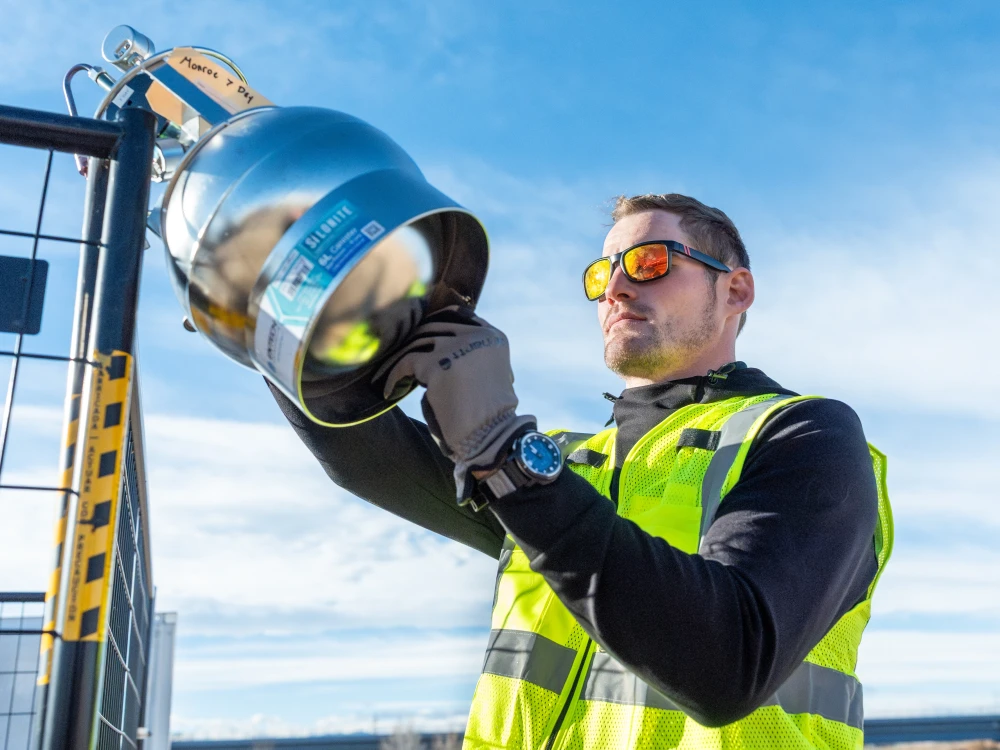
Colorado’s House Bill 21-1189 required Phillips 66’s Denver Pipeline Terminal to implement near real-time fenceline monitoring and publish air toxics data publicly every five minutes, with results available not just to regulators but to the surrounding community.
The mandate also carried a strict escalation requirement. Potential exceedances had to be validated and reported within one hour, after which the state could decide whether to activate the Integrated Public Alert and Warning System (IPAWS), sending emergency text alerts to residents within a five-mile radius. This project relied on fast, accurate and transparent air quality data and they turned to Onterris to make it possible.
Designing open-path monitoring for real-time visibility
Onterris worked with the Phillips 66 EHS and air compliance team to convert regulatory requirements into a practical monitoring design. The focus was on field constraints that impact data quality in open-path systems, including line of sight, obstructions, equipment stability and mounting height.
Onterris implemented a customized open-path network using ultraviolet differential optical absorption spectroscopy (UV-DOAS) and tunable diode laser absorption spectroscopy (TDLAS), providing continuous detection of regulated air toxics around the facility perimeter.
By calibrating equipment height to better represent potential community exposure and optimizing beam paths to avoid physical interference, the system functioned as a true perimeter network rather than a collection of isolated measurements. This ensured the data was both environmentally meaningful and defensible under regulatory review.
Five-minute public reporting that people can actually use
Publishing numbers every five minutes only builds trust when the information is clear, consistent and easy to interpret. Onterris addressed that challenge by pairing near real-time monitoring with a bilingual, public-facing reporting experience built for both community members and regulators.
Through the Sensible Environmental Data Platform (Sensible EDP™), the site displayed current pollutant levels alongside supporting weather context, health information and required quarterly reporting. Users could quickly view specific compounds and see exceedance notifications without needing technical expertise.
By integrating high-frequency open-path sensors with automated validation, we bridge the gap between regulatory rigor and real-time action. For Phillips 66, we ensured that the path from detection to public transparency is seamless, proving that compliance isn’t just a requirement, it’s a reflection of operational integrity.
One-hour validation built into day-to-day operations
HB21-1189 introduced a strict window for exceedance response. Potential exceedances had to be validated and reported within one hour, with decisions that directly affected nearby communities. Onterris worked with Phillips 66 to build that requirement into their day-to-day operations by configuring Sensible EDP™ to quickly flag potential exceedances and support documented validation and reporting.
The team also worked directly with the Colorado Department of Public Health and Environment (CDPHE) to align on next steps, including coordination outside standard business hours. The Onterris Denver team maintained 24/7 emergency response availability to support rapid decision-making and reduce risk to surrounding communities.
To ensure continuity under pressure, the program incorporated data redundancy and backup coverage so the reporting pathway remained stable, defensible and compliant at all times.
Turning data into community confidence
Phillips 66 not only met fenceline monitoring requirements but strengthened transparency and trust with the surrounding community. By pairing continuous open-path monitoring with public-facing reporting, the program delivered both speed and defensibility.
Near real-time updates, weather context and clear exceedance notifications gave the site team and community members shared awareness, enabling informed decisions when conditions changed.
For other EHS and air quality leaders, this project demonstrates a repeatable approach regardless of specific regulations: design monitoring around real field constraints from day one, embed reporting into your operational workflow and combine technical measurement with a public experience so communities stay informed and operators stay prepared.