



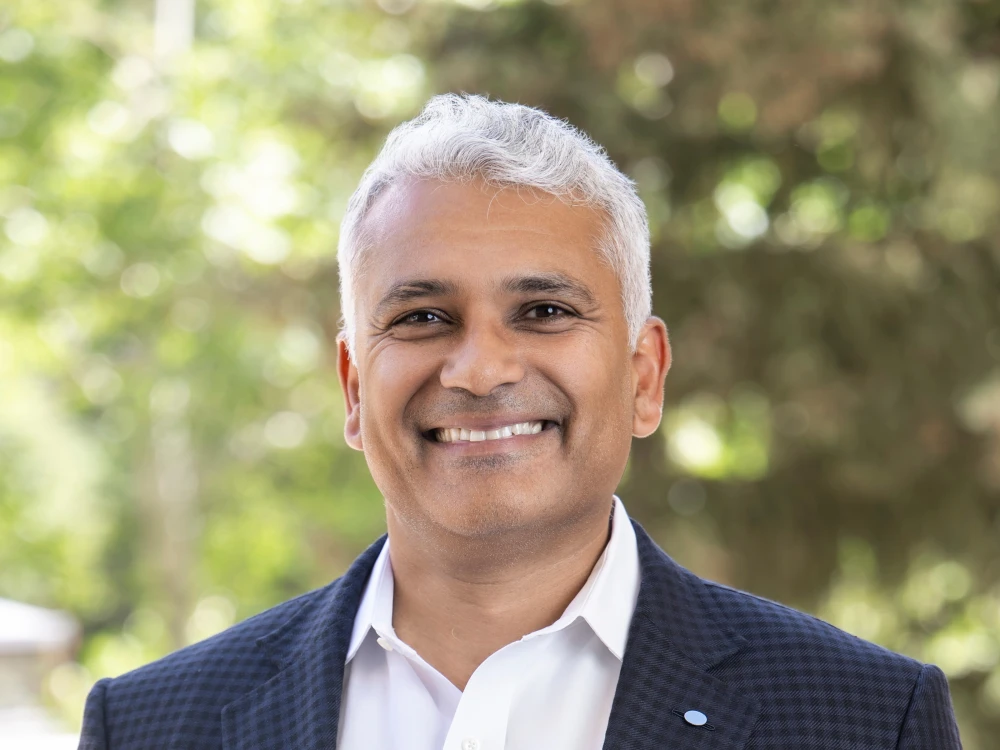
The following Q&A was originally published in Environmental Business Journal, Vol. XXXIX, Numbers 7/8 (2026). In this interview, Onterris President and CEO Vijay Manthripragada discusses the company’s evolution, the launch of the Onterris brand, the findings from the first-of-its-kind Onterris Outlook research report, and his vision for the future of environmental solutions, technology and client partnerships.
EBJ: Rebranding is never an easy decision. How long was the process of debating the pros and cons and eventually the rationale behind the move?
Vijay Manthripragada: Since the company’s founding 14 years ago, we aspired to be the brand clients thought of when facing environmental needs or challenges. As we rapidly scaled, we reached a point where our size, technical depth, geographic reach and breadth of capability had outgrown the way we were presenting ourselves to the market. We were a family of brands and our commercial approach was service specific. Clients were not always aware of our technical solutions or services being part of a whole. More importantly, our clients were asking for more than individual services. They were asking for a partner who could help them navigate a much more complex environmental landscape holistically.
The decision to rebrand was about simplifying and expanding our commercial strategy. It was also about further integrating our people and culture across the world. It has been a strategic objective for a while but the timing and investment were carefully calibrated. We hired specific talent and engaged third party experts to deliver this outcome.
EBJ: Did you involve a wider group of employees and solicit suggestions or actual names, did you engage external marketing consultants or was it a fairly tight-knit internal process of the strategic marketing team?
Manthripragada: It was a disciplined brand strategy process, guided carefully by our strategic marketing and communications team, informed by extensive research, and brand transformation expertise. A core part of the approach was listening to voices that matter most: our people and our clients.
Our people wanted something that had meaning and united all our legacy brands. We spent significant time pressure-testing what the company stands for, what clients want/need from us, and what kind of name and identity our employees would be proud of. Onterris combines on, meaning motion and intent, with terris, meaning Earth. It reflects our belief in solutions that start from the ground up: science with its feet on the ground, innovation rooted in place and a belief that progress happens where people and planet meet.
The visual identity was inspired by the “pale blue dot” image captured by NASA’s Voyager 1 from over four billion miles away – everything we care about is on this pale blue dot we call home which reminds us of our shared responsibility while we continue to progress human and economic development. Hence our north star – For Planet & Progress.

EBJ: Remind us how many acquisitions the firm has done over its history, and how did you approach the integration in those cases regarding the branding of the acquired company and then the branding transition to Montrose and then Onterris now?
Manthripragada: Acquisitions are only half of our growth story. For example, since our IPO in 2020, the company has grown at a ~25% revenue CAGR of which 13% is organic growth. So integration to us is well beyond acquisition integration. It is also about integrating the hundreds of colleagues that choose to join us every year.
As for acquisitions, we have completed more than 70 acquisitions since our founding in 2012. That history is central to understanding why this brand evolution matters. Historically, our approach to integration was disciplined but more focused on the ‘back office’. Many of the businesses we acquired had deep client trust, strong local reputations and specialized expertise. So we integrated systems, processes, policies, and safety standards, for example, but we preserved the client relationships and go-to-market approach that made each business successful.
The transition to Onterris now integrates our client relationships and go-to-market approach. It brings together legacy brands including Montrose Environmental, ECT2, CTEH, Enthalpy Analytical, Matrix Solutions and Epic Environmental under one global identity, creating a simpler and more consistent experience for clients and partners. It also accelerates the integration of cultures and shared values. As we continue to grow, operating as one powerhouse brand gives us a stronger platform for future acquisitions.
EBJ: Does the name change involve any change in strategy or how you divide your services groups or how you go to market?
Manthripragada: Our strategy is the same. This is not a departure from our strategy; it is an expression of it. Onterris makes our strategy more visible, more accessible and more actionable by uniting our consulting, testing, measurement, analysis and treatment expertise under one platform.
What changes is the clarity with which we show up: to our clients, our people and our investors. Onterris gives clients a clearer way to access the full breadth of what we do, while giving our teams a stronger platform to collaborate, innovate and create impact at scale.
EBJ: In your new report you emphasize the elevation of environmental strategy across leading corporations and a growing share of companies in the middle. How are you reacting to and approaching these changes in terms of service offerings like advisory consulting, climate resilience or a new definition of sustainability?
Manthripragada: What The Onterris Outlook confirms is what we are hearing from clients every day: environmental performance has moved from a compliance function to a core business discipline. That shift reflects exactly why we became Onterris. Clients want a partner who understands the full system.
That is central to our brand evolution. Onterris is built around a systems-thinking philosophy: environmental challenges are interconnected, so solutions must be integrated. Our scale and breadth of expertise allow us to see the full landscape, understand how issues influence one another, and help clients address them across the entire system. The report reinforces this point, showing that stronger environmental performers are seeing real business benefits, including improved access to capital, greater competitiveness and cost savings across energy, water and waste management.
Read the Report
Our response is not to add a new “sustainability” label or suggest these are entirely new categories. By addressing the whole system, we are already providing solutions to what some consider ‘emerging’. Sustainability is becoming more practical, operational and outcome-driven, not an ‘ESG’ or ‘check-the-box’ exercise. It now includes resource efficiency, cost reduction, regulatory certainty, liability management, resilience, capital access, asset reliability, supply chain stability and community trust. Some of these goals often work in tension which is what makes it interesting and which is also why innovation is central to our approach. Environmental stewardship and industrial, financial and social progress are no longer separate conversations.
That is why Onterris is organized around an integrated solutions platform built for the full lifecycle of environmental stewardship. We have dedicated solution expertise and sector-focused leadership across Permitting & Compliance; Planning, Preparedness, Response & Recovery; Contaminated Land & Remediation; Testing & Analysis; Health, Safety & Chemistry; Water Consulting, Testing & Treatment; Community Resiliency; Natural & Cultural Resources; and specialized Treatment Technologies. Each area can address a distinct client challenge, but the greatest value comes when they work together across the full system.
Advisory consulting is a good example. A client may start with strategy, risk assessment or regulatory interpretation, but they also need defensible data, monitoring, laboratory testing, field execution, treatment technologies and long-term performance support. Our model connects those capabilities into one coordinated system. Science, data and delivery cannot be fragmented if clients are expected to make confident decisions in a more complex environment.
Climate resilience is similar. We have dedicated capabilities in climate risk management, climate impact assessments, adaptation planning and resilience strategy, but we approach resilience as more than disclosure. It is about helping organizations understand where environmental threats intersect with operations, infrastructure, people, assets, supply chains and long-term stability.
We partner with clients to protect air, water and soil while helping them operate responsibly, reduce risk, improve efficiency, preserve asset value and strengthen resilience. Environmental performance is now business performance, and Onterris is built to connect those outcomes at scale.
EBJ: What role is technology playing and how important is that to the future of the company more broadly the environmental and climate change industries?
Manthripragada: Technology is foundational to where Onterris is going, but it is not the story. The story is what technology lets us - our people - do for clients.
Environmental performance now turns on data: how quickly you can capture it, how confidently you can interpret it, and how reliably you can act on it. Onterris generates that data through our own sampling, testing, monitoring, and field operations across every major environmental medium. That data chain has always been core to us, and it is now what makes a credible AI strategy possible. We recently hired our first CTO to accelerate the investment behind that thesis. The near-term focus is automating internal work that does not differentiate us, so our scientists and engineers spend their time on the work that does.
We are building all of this on a unified enterprise data platform with responsible AI guardrails embedded from day one. Every AI system that touches client data, regulated processes, or financial systems is reviewed by legal, security, and data science before deployment. That is a deliberate choice. Environmental data is high-stakes data. Speed without accountability is the wrong trade.
The broader environmental and climate change industries will be reshaped by AI over the next three to five years. The winners will be the firms that combine deep technical expertise with proprietary data and disciplined technology. That is exactly what Onterris is built to do.
EBJ: What was your own personal motivation to get in the industry, and how did that evolve into an executive or senior management position?
Manthripragada: My uncle was appointed by President Reagan in the late 1970s/early 1980s to help start the IPCC so I’ve been exposed to environmental science from an early age. I recall dinner conversations in middle school about how the private and public sectors were assessing and tackling acid rain and ozone depletion. The challenges and the implications for communities are significant. Wanting to help is part of what drove me to focus on science while in college.
For me, the attraction to this industry has always been that the work matters in a very tangible way. Environmental challenges are not abstract. They affect communities, public health, industries, markets, infrastructure, water, air, soil and the future we are leaving behind for our children and grandchildren.
That became even more personal as I raised a family. You start to think differently about responsibility, legacy and the kind of world the next generation will inherit. For me, this work has always been about helping make that future better, while recognizing that the world still has very real industrial, economic and infrastructure needs. As my career evolved, what became clearer is that leadership in this industry is not just about delivering services. It is about taking responsibility for the outcomes we influence. Key industries need to grow, modernize, produce, build and power the world. Our role is to help them do that responsibly, as environmental stewards, while bringing forward the science, technology and leading-edge solutions that can transform our industry.
That is really what Onterris represents. It is a company built by scientists, engineers, field teams, consultants and professionals who turn expertise into action every day. My role is to help create the conditions for that expertise to have greater reach and greater impact. That is why this rebrand is so meaningful. It is not just a new name. It is a statement of responsibility, ambition and confidence in what our people can do together - for planet and progress.
About Onterris
Onterris is a global environmental solutions company partnering with organizations to solve complex challenges where environmental pressures, regulatory expectations and operational risks intersect. Guided by a mission to advance the way of life without compromising the integrity of our environment, we believe environmental responsibility and human progress are fundamentally connected. Onterris scientists, engineers, field teams and consultants apply systems thinking that unites science, data and practical expertise to understand environmental systems, not just symptoms. By bringing together capabilities across disciplines and geographies, the company helps organizations address interconnected challenges with solutions grounded in environmental science and informed by real-world operational experience.